FocuX: Designing a Polite Intervention System for Digital Nomads
How a wearable, an iPhone, and an embodied lamp became a system that notices work strain without stealing attention.
On this page
This is a web adaptation of my undergraduate thesis, submitted to Shenzhen Technology University on April 28, 2026. The project was developed from October 2025 to April 2026. The downloadable thesis is the original Chinese edition; this article reorganizes it around the product decisions, evidence, and limits that matter most on the web.
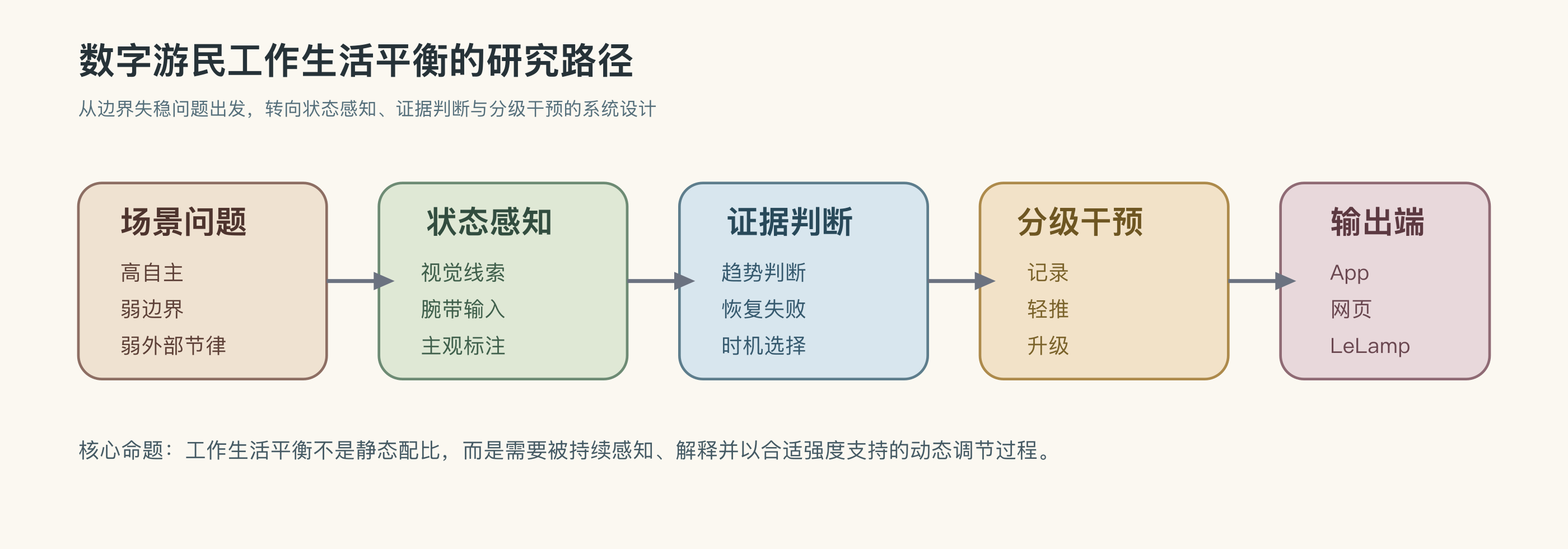
FocuX began with a contradiction: digital nomads gain freedom over where and when they work, but lose many of the boundaries that once told them when work should end. There is no commute to create a transition, no office rhythm to follow, and often no colleague nearby to notice that concentration has already turned into strain.
The project asks a narrower and more useful question than “How can we make people more productive?”
How might a system notice when work is going off course, wait until help is justified, and intervene without becoming another source of interruption?
The problem is not time management
Existing tools cover fragments of the problem. Task managers know what someone planned to do. Health trackers summarize how the body behaved yesterday. Fixed reminders can say “take a break,” but they rarely understand whether this is the right moment to interrupt.
What remains missing is the middle layer: understanding how work is unfolding now, deciding whether the evidence is strong enough, and choosing the lightest useful response.
This reframes work–life balance from a static allocation of hours into a continuous interaction problem. Balance is not a score to check at night. It is a series of small decisions made while work is still happening.
From a detector to a product
The first prototype, Damp, tested whether a small wearable model could distinguish broad work and rest states. It proved that the sensing direction was possible, but it also exposed a larger problem: a lab signal pipeline is not yet something a person can live with.
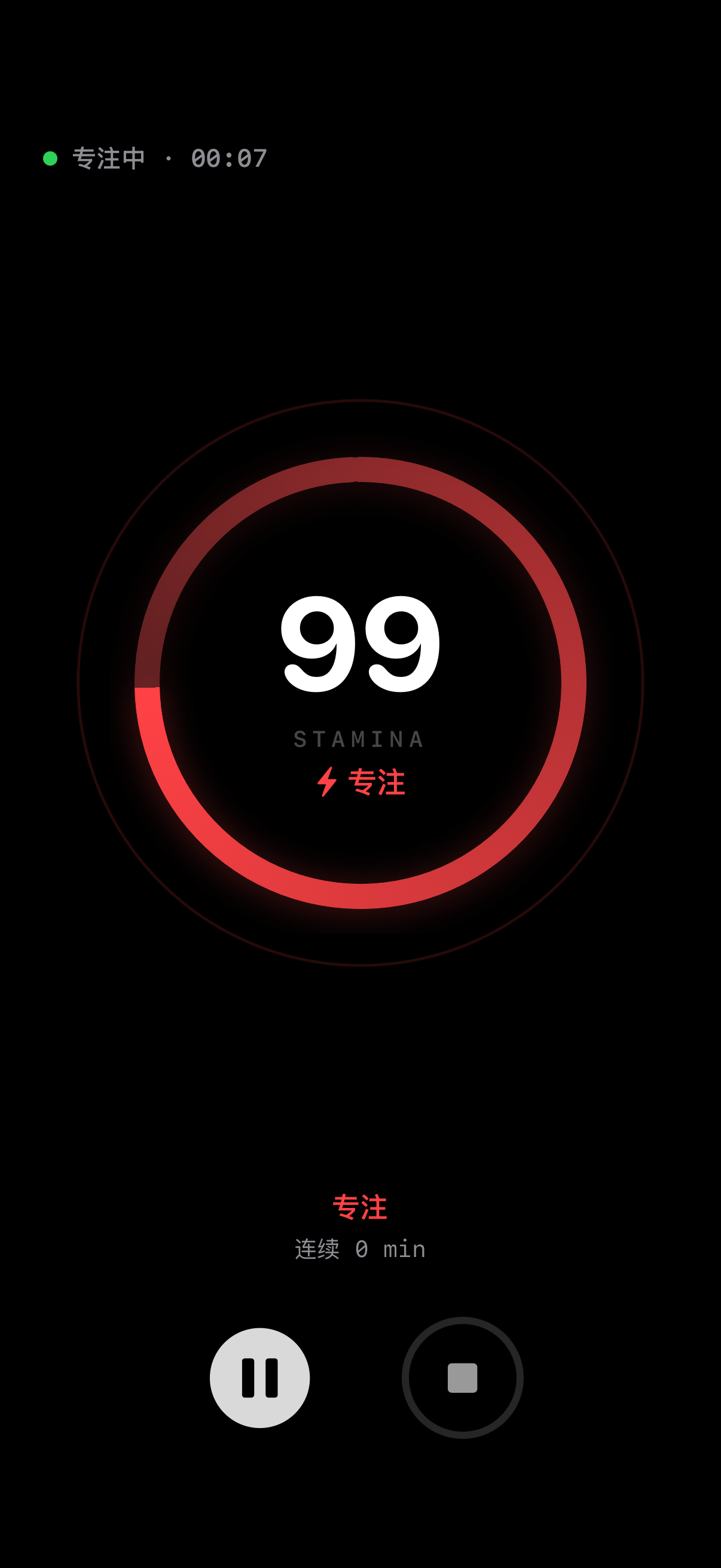
The second iteration became a native iOS product. The wearable connected directly to FocuX, personal calibration replaced a one-size-fits-all baseline, and raw body data stayed local by default. The design expanded beyond a single score into a session flow: start work, notice change, understand why, and review what happened later.
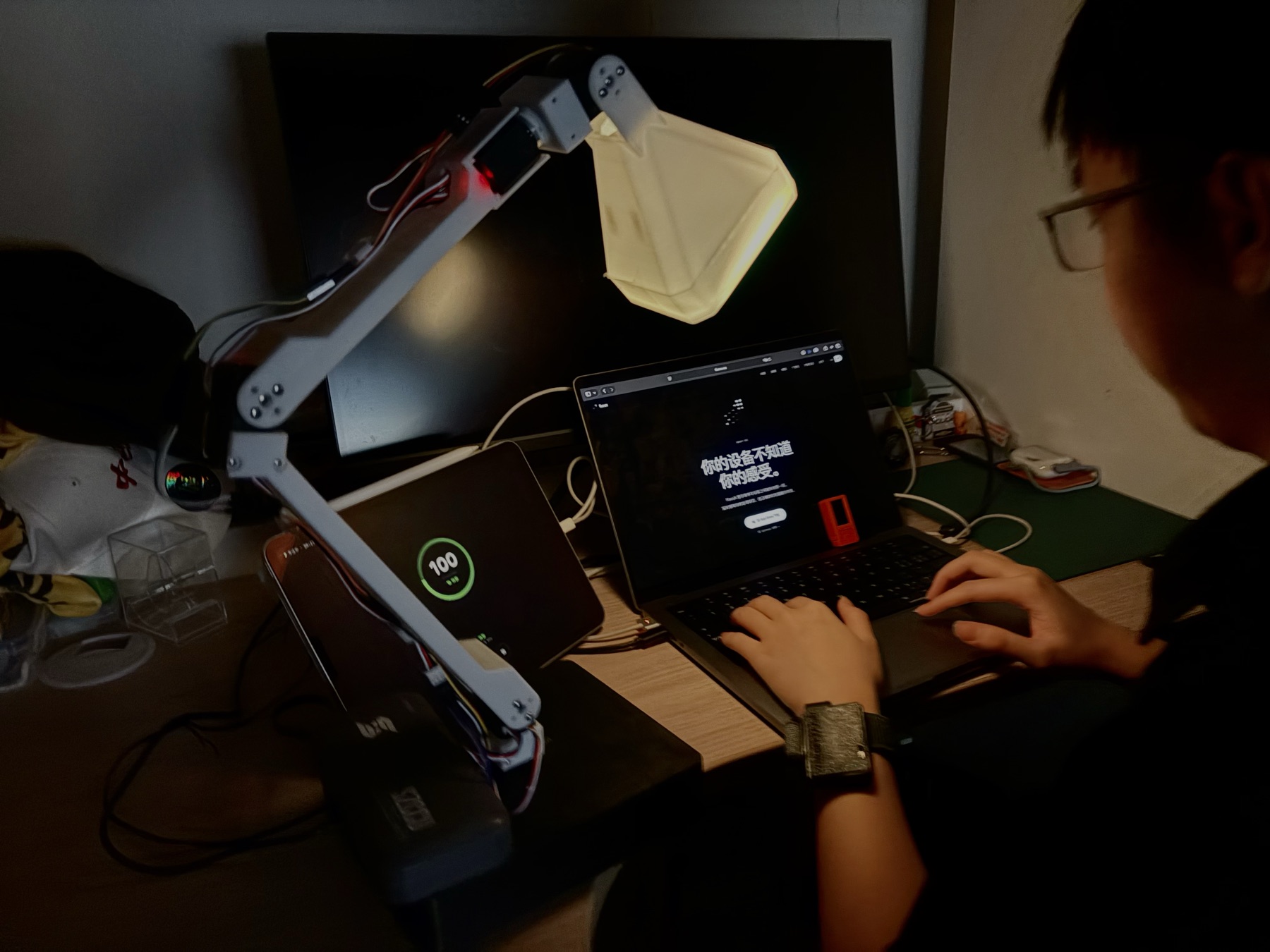
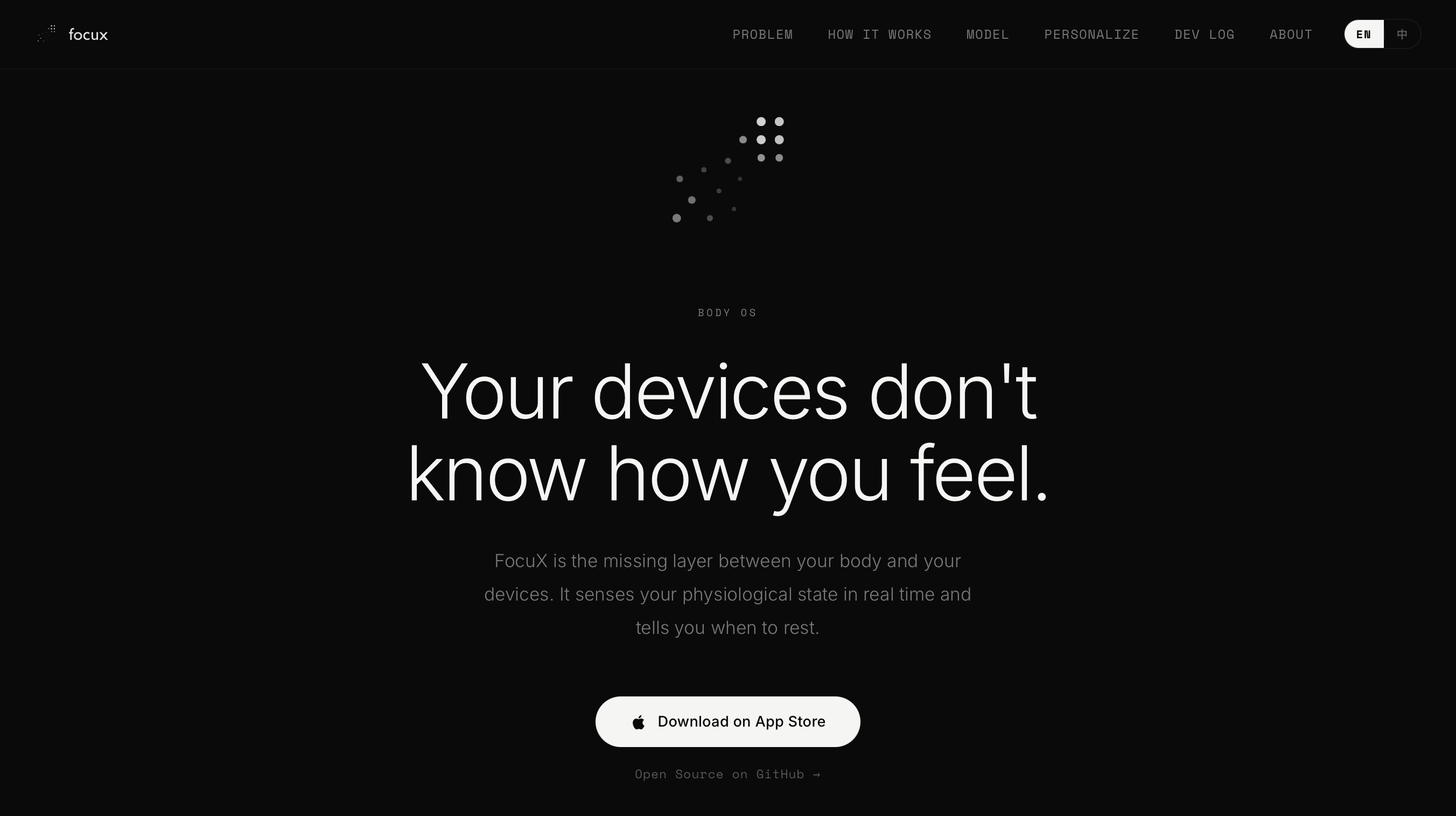
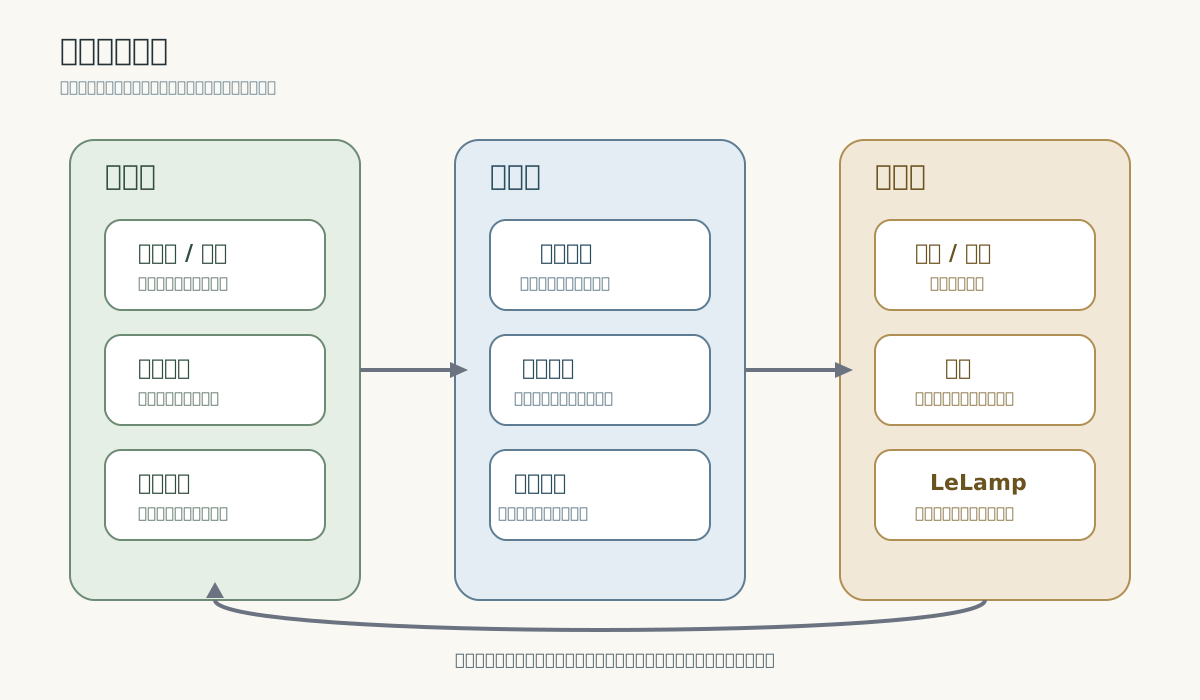
The third iteration moved beyond the phone. A lightweight web entry added visual context; a cross-device harness turned different signals into one continuous state stream; and LeLamp became an embodied consumer of that stream. The system could now decide not only what it noticed, but also whether to appear, how strongly to respond, and when to return to the background.
One state, many possible responses
FocuX is not a medical diagnostic system and does not treat a physiological signal as a psychological truth. The wearable, camera, session history, and subjective feedback provide pieces of evidence. The system organizes those pieces over time before deciding whether a response is warranted.
The current prototype can be understood as five connected parts:
- Sense — collect body, motion, visual, and self-reported cues.
- Interpret — look for persistence, recovery failure, and contextual risk rather than reacting to one spike.
- Share context — broadcast one normalized state across the phone, website, and embodied devices.
- Choose a response — decide the timing, intensity, and output channel.
- Remember — turn a session into a recap that can inform the next interaction.
The polite intervention curve
The product principle is simple: evidence before interruption.
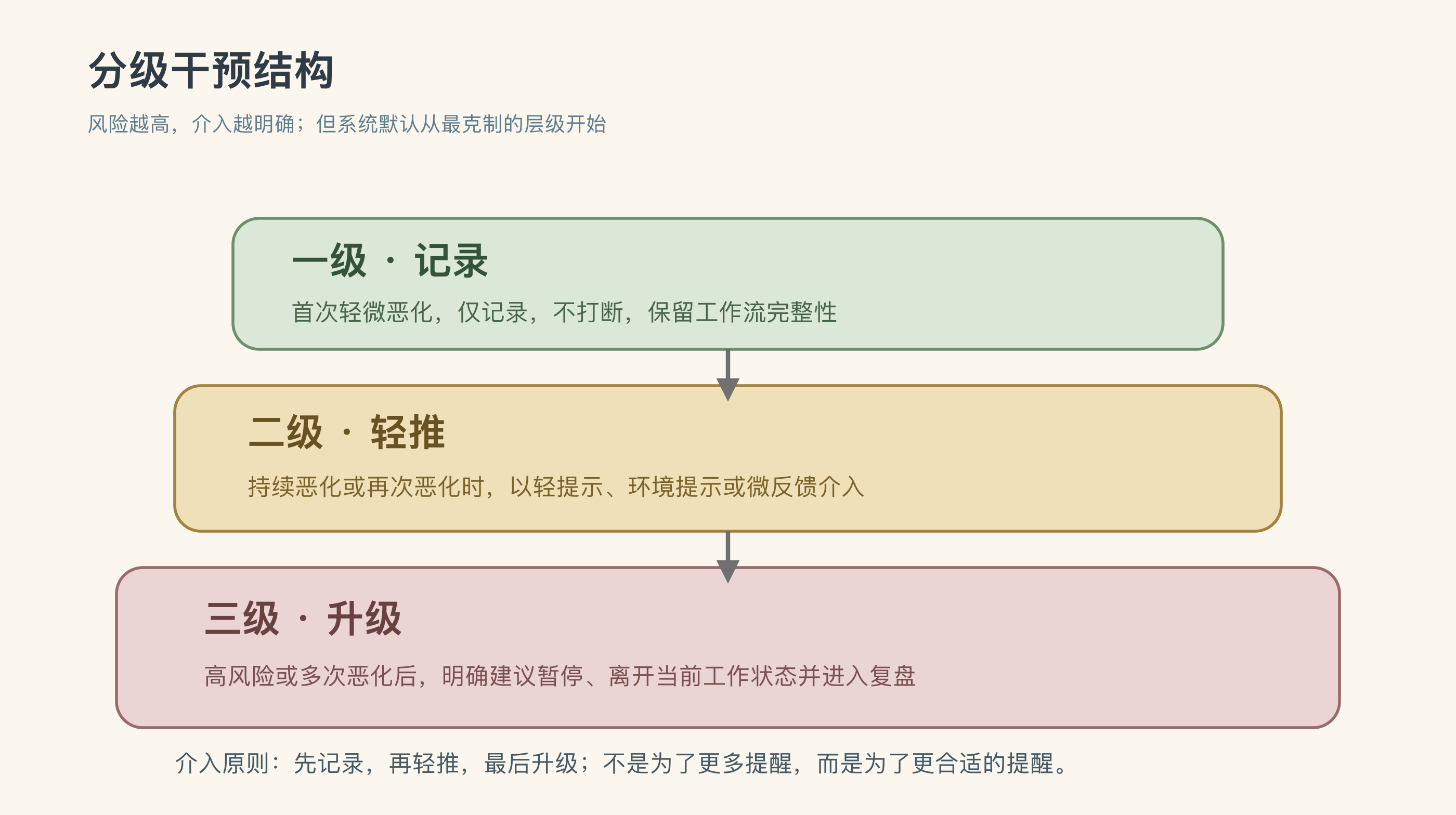
FocuX starts from the quietest level and earns the right to become more explicit:
- Silent log — record an early change without breaking the flow.
- Light nudge — offer a small environmental or interface cue when the pattern persists.
- Escalation — recommend a pause or review only when risk or repeated deterioration makes interruption defensible.
This is not a strategy for sending more reminders. It is a strategy for making fewer reminders matter more.
Why a lamp instead of another notification?
Screens are already where the work—and most interruption—happens. An embodied output can remain perceptible at the edge of attention and move into the center only when necessary.
LeLamp supports two response philosophies. A motion path uses direction, posture, and a small gesture when the moment needs a clear signal. A breath path uses slow light and movement to create a quieter co-regulation cue. One behaves like a colleague gently knocking on the door; the other feels more like the room lowering its voice.
The physical lamp design originates from the open-source LeLamp project by Human Computer Lab, inspired by Apple’s ELEGNT research. My contribution was to connect that open hardware to FocuX’s state stream and build the timing, gating, intervention budget, and runtime behavior that decide how it participates.
Early evidence, with clear limits
On April 27, 2026, I ran an early paired study using the same participant and the same type of structured knowledge-work task, once without assistance and once with FocuX assistance.
The assisted session finished 17.05% faster, used 38.33% fewer field inputs, and reached the first useful action 31.52% earlier. Mean PERCLOS, used here only as a directional visual-alertness cue, was 34.25% lower. The total number of errors did not meaningfully disappear; instead, errors moved from scattered trial and correction toward one late, high-stakes checkpoint.
That last change is the most useful product insight. The next version should not increase reminder frequency. It should become better at recognizing the one moment where help is worth the interruption.
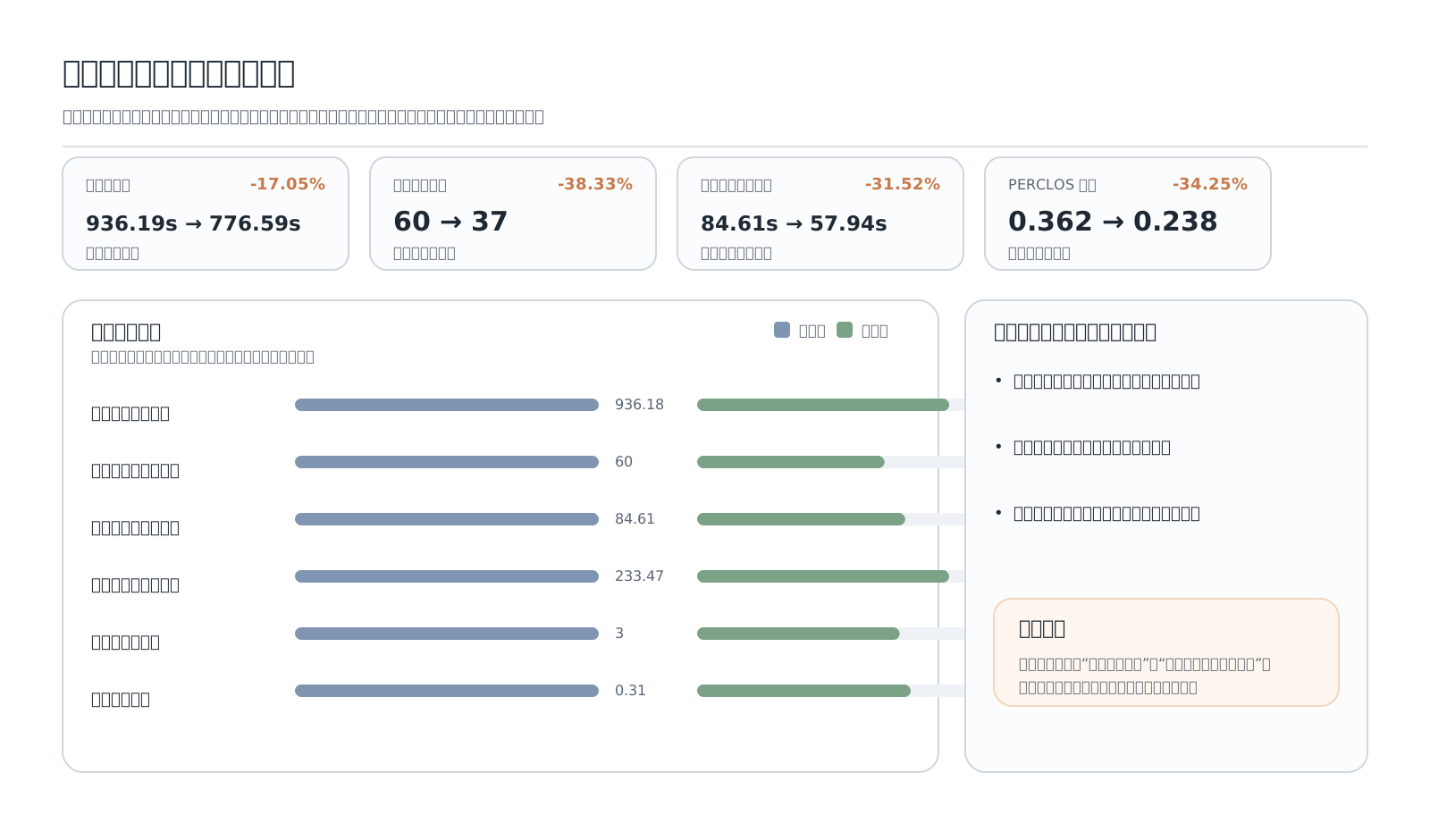
The boundary matters: this was an N=1 formative test lasting roughly 13–16 minutes. It cannot establish general effectiveness, long-term behavior change, or clinical value. Its role was to reveal where the current product creates friction, where it may create value, and what the next study should test with more participants and longer use.
What the thesis contributed
Looking back, the thesis made three translations:
- From hours to moments — work–life balance became a question of state, timing, and support during work rather than a retrospective time score.
- From one device to one context — the wearable, iPhone, web entry, and LeLamp began sharing the same evolving state instead of issuing disconnected judgments.
- From notification to presence — intervention moved beyond the screen into motion, light, and spatial behavior that can be present without immediately taking over.
The result is not a finished universal solution. It is a working argument: technology can support self-regulation more respectfully when it first learns to stay quiet.